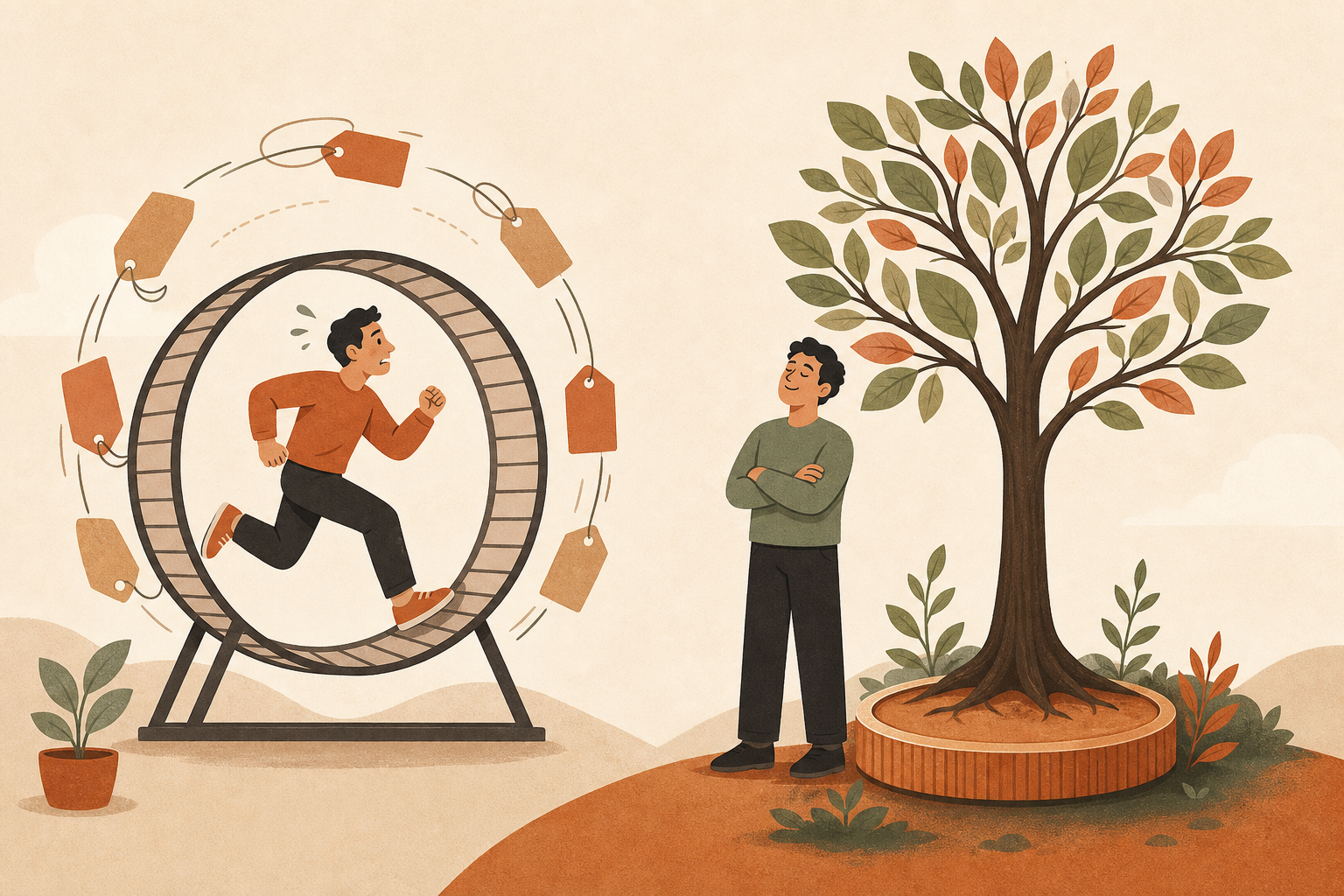
You know the feeling. Your website looks like it's from 2015. You're running the business out of spreadsheets. You're doing by hand the kind of work a decent tool could do for you in the background.
And every time you think about fixing it, the same sentence shows up: "I can't afford that right now."
I want to gently push on that, because most of the time it isn't actually true. You're already paying for the problem. You're just paying for it slowly, in time and missed chances, instead of all at once.
The real question isn't the price tag
When a proposal lands, most owners ask, "How do I spend the least right now?" The more useful question is the one almost nobody asks: "What is it costing me to leave this broken?" That single shift is most of the difference between feeling broke and being smart with money.
Cry once, buy once
There's an old line I keep coming back to: cry once, buy once. Pay what the right thing actually costs, one time, instead of buying the cheaper version again and again because it never quite does the job. The bargain version doesn't save you the money. It just spreads the spending out and adds frustration on top.
You're not buying a tool. You're buying your time back
Let's be honest about where your hours are going. Maybe you're keying the same data into three different systems. Maybe Friday afternoons disappear into fixing the same thing that breaks every week. Maybe you've quietly turned down bigger work because you knew your setup couldn't handle it.
You don't need me to invent scary numbers for that to sting. You already know what an afternoon of your time is worth, and you already know how it feels to watch a good lead go cold because something on your end wasn't ready. That's the real price of "too expensive." It's just paid in a currency that doesn't show up on an invoice.
The cheap route usually costs more
I've watched this play out more times than I can count, and it tends to go the same way.
Someone buys the cheap template. It loads slowly, looks like everyone else's, and converts almost nobody. A few months later they're paying to patch it. A year later they're paying again to build the real thing. The "savings" became a down payment on doing it twice.
Or they hire the cheapest freelancer for a quick fix. The fix breaks. Another freelancer comes in to fix the fix. Now five tools are duct-taped together, nothing talks to anything, and a chunk of every week goes to just keeping the lights on.
Or they try to run everything on free apps that don't sync. Data drifts. Small errors pile up. It isn't saving money so much as quietly manufacturing chaos.
The cheap option always looks best on day one. It rarely looks good on day one hundred.
Think like an architect, not a handyman
When your roof springs a leak, you call a handyman. He patches it, you pay him a little, everyone's happy. That's the right call for a leak.
But you don't build a house you plan to live in for thirty years by patching. You bring in someone who plans it to last. You're not solving this week's problem; you're building something you'll stand on for years.
Most owners run the whole business in handyman mode: react, patch, survive. The ones who actually grow tend to think like the architect on the parts that matter. They put real systems in place that work together, and they stop re-buying the same fix. It costs a bit more up front. It's also the only version that scales when the bigger clients finally show up, because cheap infrastructure has a habit of buckling at exactly the moment you can least afford it.
This is the part that feels scary
Spending real money on something you can't hold in your hand is uncomfortable. You earned that money. Of course it feels like a risk.
But you're already spending it. You're just spending it in slow leaks, scattered across a dozen places you've stopped noticing. The only real choice is whether it goes toward another patch that gets you to next quarter, or toward something that actually moves you forward and then mostly leaves you alone.
Choosing "good" over "cheap" isn't spending more. It's spending once, on purpose, on the thing that pays you back.
The decision that changes things
The owners I work with who genuinely grow all share one quiet decision: they figured out their time and their future were worth more than the lowest invoice. Not recklessly, and not without thinking it through. They just stopped reacting and started building.
So the next time a proposal feels like a stretch, sit with one question:
Is this the cheap patch I'll be redoing in six months, or the thing I pay for once and then stop worrying about?
Your answer usually decides whether you stay stuck or finally move.