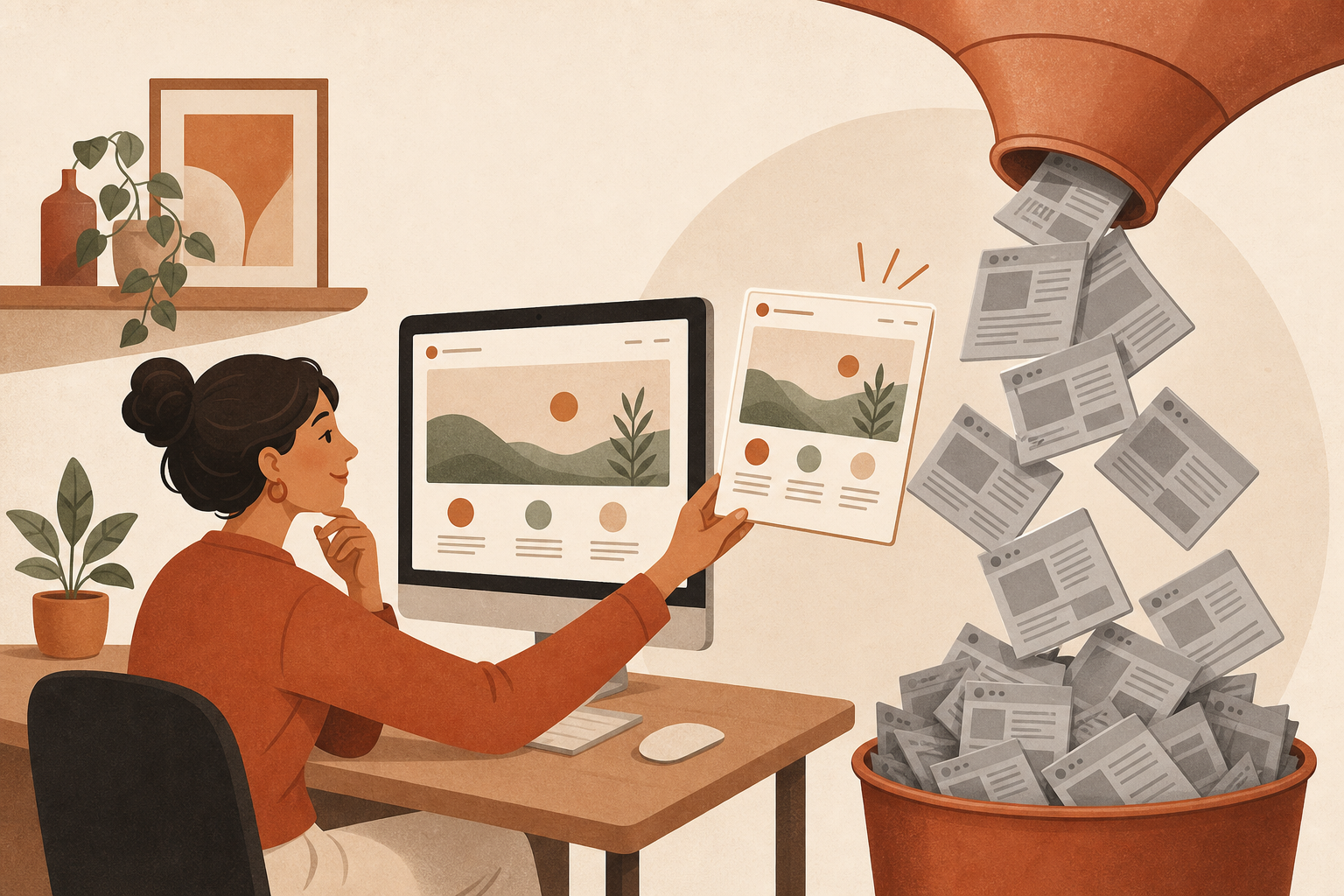
I use AI every single day, and it's genuinely changed how I work. It's fast, it takes the tedious stuff off my plate, and it frees me up for the decisions that actually move the needle.
But here's the part nobody tells you: AI is a power tool for people who already know what they're doing.
When I hand something to AI, I'm steering it the entire way. I catch the mistakes because I understand the problem well enough to know when something's off. I rework the output because I have context the model never will. It sits on top of a foundation that's already there.
Most people reaching for AI right now don't have that foundation yet. And on a website, that gap shows up fast.
The False Promise of "Anyone Can Do This"
Website builders and AI tools all show up with the same friendly promise: you don't need a designer, a copywriter, or a developer. Anyone can make something professional.
The first half is true. Anyone can make something. But "I made something" and "I made something professional" are two very different sentences.
The tools are so smooth that they create a confidence gap. The interface feels polished. The templates look sharp. The AI suggestions sound reasonable. So you hit publish feeling good about it.
Then a potential customer lands on the page and quietly thinks: this person didn't hire anyone.
It's not that they're judging you. They just feel it. The copy reads like it came from an algorithm, because it did. The layout feels generic, because thousands of other businesses are using the same template. The whole thing gives off one impression: this person is trying to spend as little as possible on their website.
Which plants a quiet little question: what else are they cutting corners on?
What Experience Actually Buys You
I lean on AI constantly. The difference is that I can do the one thing an amateur can't: I can tell whether what it gave me is any good.
I know when code is held together with tape. I know when copy is technically fine but emotionally flat. I know when a design choice looks nice but quietly works against the person trying to use it. I know because I've made just about every one of those mistakes myself, and the mistakes are what taught me what "good" actually looks like.
Someone newer to this doesn't have that filter yet. So the first draft becomes the final draft. It gets published. And the website ends up sending the exact wrong message: I didn't know enough to tell the difference.
That's usually not even true about the person. But on the web, people decide how they feel about you in about seven seconds, and they decide with their gut.
The Real Problem With AI Copy
This is where I watch the most damage get done.
AI copy is competent. It's grammatically clean. It hits all the usual sales beats. It reads like a website. That's exactly the problem. It reads like every website.
The model doesn't know your customers' real fears. It doesn't know the specific way your trade works, the questions people actually ask you, or the thing you do better than everyone down the street. It has no point of view, because it isn't a person who has lived your work.
Copy that actually moves people comes from someone who understands the problem deeply and genuinely cares about solving it. AI can imitate the shape of that. It can't manufacture the substance. Using a template for your story is like introducing yourself with a form letter. The facts might be right, but it doesn't sound like you. And people can hear the difference.
The Design Trap
The templates are genuinely good now. I mean that. They're clean, responsive, modern. And they look like templates.
The moment you're one of thousands of businesses using the same starting point, you blend in instead of standing out. Your site looks fine on its own. But your customers never see it on its own. They see it right next to three competitors, and that's where "fine" starts to read as "forgettable."
Good design isn't about looking flashy. It's about being deliberate. Every real decision (the type, the spacing, the color, the order things appear in) should be doing a job for your specific business. A template can't do that, because it was built to appeal to everyone, which means it's tuned for no one in particular.
What This Quietly Costs You
I'm not going to throw scary math at you. That's not the point.
But be honest with yourself for a second: if someone lands on your site and immediately senses you went the cheapest route, how likely are they to hand you something important? Not very.
And here's the part that stings. Even when they do hire you, you've already told them price is what matters most to you. So they'll push on your fees. They'll ask for the discount. They'll treat you like a commodity, not because you are one, but because your website introduced you as one.
So What Should You Actually Do?
I'm not telling you to go hire a big agency. I'm not telling you to spend a fortune. I'm telling you to be honest about what you don't do well.
If you're not a designer, don't try to wing the design.
If you're not a writer, don't let AI stand in for the actual thinking good copy takes.
If web strategy isn't your world, don't guess at it.
There are professionals who do this for sensible money. Not everything is a $20,000 project. Plenty of experienced freelancers and small shops will build you a genuinely professional site, with custom copy and design that speaks to your business, somewhere in the $3,000 to $8,000 range.
And that kind of investment tends to pay for itself, not in some hand-wavy way, but in real clients who trust you because your website makes it obvious you know what you're doing.
The Kindest Thing I Can Tell You
I've watched a lot of sharp business owners quietly hurt themselves trying to DIY their way online. Not because they weren't capable. Because nobody told them that building a website takes a different set of skills than building a business.
Just because you can build something yourself doesn't always mean you should.
The owners who are winning, the ones pulling in good clients and charging what they're actually worth, figured this out early. They put their energy where they're strong and brought in help where they're not.
So if you're about to build your site with AI and a template, I'm honestly not judging you. I just want you to see the choice clearly. Your website is making a promise about your business before you ever say a word. Make sure it's the promise you actually mean to make.